From Reactive to Strategic:
Building a Design Operation

Client
Team
Industry
Note
Enterprise Event Management · B2B
Product Trio and 3 developers plus a QA
Hospitality Sports
Sensitive data has been protected
for NDA compliance
Main Impact
2 days → 15 min: Time saved on a critical task
20% estimated reduction rework:
Early research and validation reduced uncertainty before implementation, helping prevent additional iterations after delivery.
100%: Platform covered by heuristic audit
3: Critical flows restructured
4: Product streams addressed
Overview
This project focused on transforming a 20-year-old legacy platform used to support major international sporting events. The challenge was not only to improve individual features, but to establish a more structured way of identifying, prioritizing, and solving problems across the platform while preparing it for future SaaS opportunities.
I worked across multiple product streams, combining urgent business requests, user pain points, heuristic evaluation, and stakeholder input to identify opportunities and turn them into validated improvements.
Objectives
01 Prioritize high-impact opportunities
Establish a structured prioritization framework that balanced business urgency, user pain points, team capacity, and potential impact.
02 Improve critical user experiences
Identify and restructure high-value workflows, using research and heuristic evaluation to reduce friction and improve usability across the platform.
03 Build for future scale
Establish reusable foundations, documentation, and Design System capabilities that could support future SaaS and multi-brand opportunities.
Constrictions
The team had limited stakeholder availability and a constant flow of urgent business requests. Traditional discovery sessions were difficult to schedule, while feature requests still needed to be evaluated, designed, and delivered.
Instead of treating urgency as a blocker, I used it as a research window. Discovery was embedded directly into existing requests, combining stakeholder interviews, heuristic evaluation, user-based reports, and structured prioritization to turn reactive work into a continuous learning cycle.
Key insight: Urgency became our research window.
Limited stakeholder availability meant we had to embed discovery into existing urgent requests rather than scheduling separate sessions

The challenge
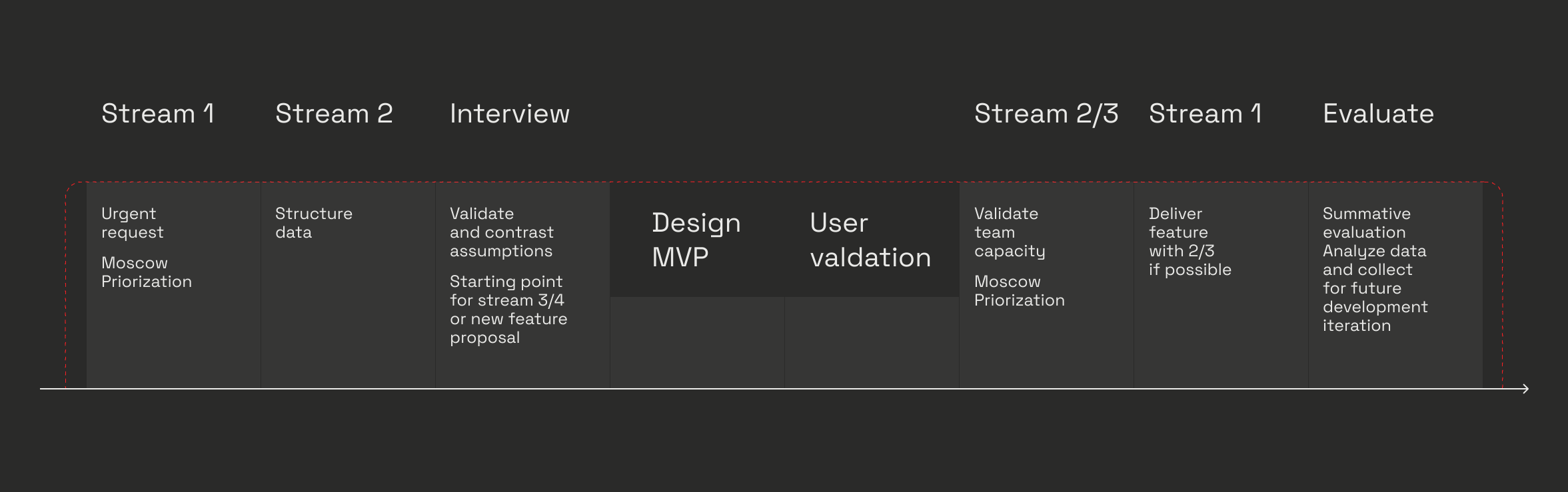
Group requests managment framework
Stream 1
Urgency business
feature requests
Stream 2
User based report
pain points
Unstructed data
Stream 3
Heuristic evaluation
Quick wins
Stream 4
Features to decrease support tickets
Design from reactive to strategic
Solutions
Stream 1
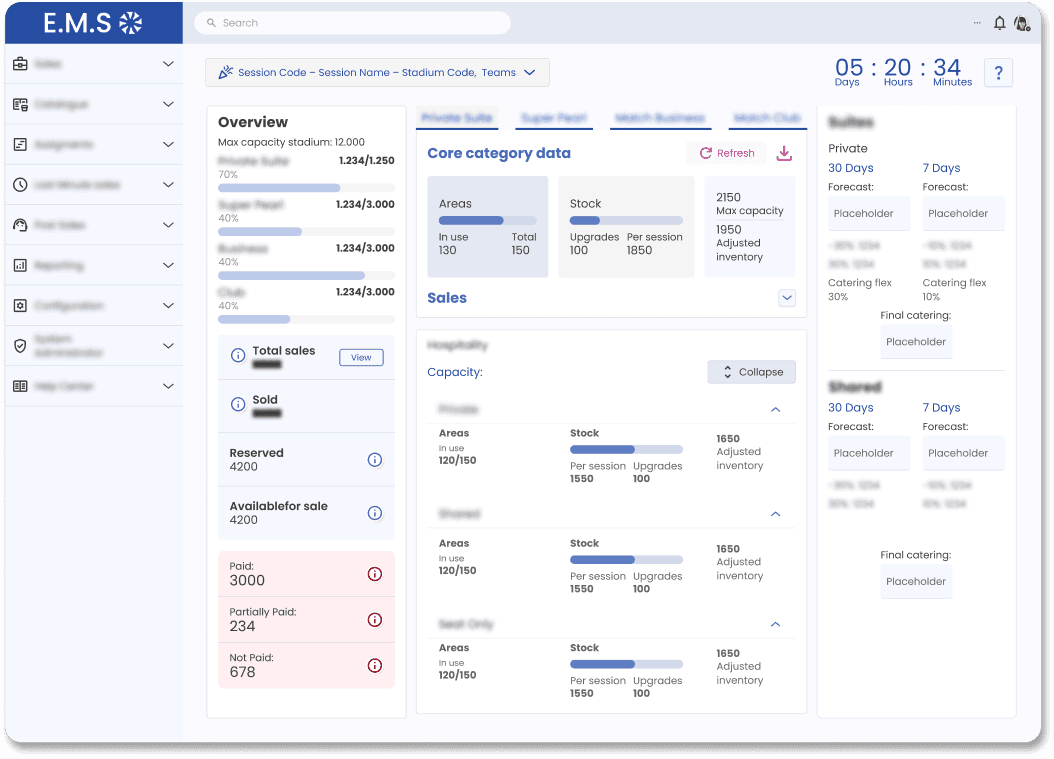
Dashboard
Project
Solution
Dashboard
From reactive to proactive operations: Teams could anticipate catering demand based on current sales instead of responding after demand had already materialized.
Faster decision-making: During cross-department meetings, everyone could work from the same live information and make operational decisions in the moment.
Better cross-functional alignment: Sales, catering, operations, kitchen, and management could see the same picture, reducing assumptions and communication gaps.
Synthetize data that facilitates
business desicions
Stream 2
From single creation to automization
The project started with a seemingly simple request: “Fix product import.” However, looking at the existing workflow revealed a deeper problem. Products were created individually in the platform, while variations and bulk changes had to be managed externally through spreadsheets. Creating a product required around 20 inputs and coordination across different departments, taking up to 16 hours before the product could be fully agreed and created. When multiple products needed updating, teams had to export, edit and re-import the data.
This shifted the problem from
“How do we improve the import screen?” to “
Why does product management depend on imports in the first place?” The solution was a matrix-based product generation model: instead of creating and editing every variation individually, users define the key event variables, such as product type, catering, parking and dates, and the system automatically generates the required combinations. This removed the need for external bulk editing and centralised product creation within the platform.
Stream 3
SaaS documentation

Solution
Impact
A support center with documentation
version avaliable and follow up on recent updates inside the platform
Better communication about
improvements from the dev department to the steakholders inside the platform
Stream 4
Automization of documents

Friction
Documents such as invoices and product descriptions required frequent, minor adjustments, changes as small as color tweaks or shifting an element a few pixels. Because the previous tool had a steep learning curve and required technical knowledge, every edit had to be routed through the dev team. In the two weeks before the redesign, one developer was fully occupied handling these requests instead of core engineering work.
Solution
We interviewed each department to see who edited templates, when, and why. Based on that, I designed a tool that scans Word documents and saves them internally, keeping up to four versions with a record of who edited what and when. Departments can download, edit, and re-upload the Word file directly, removing the dev team from the process.
Impact
Stream 1
Urgency business
feature requests
↓
Foundation for SaaS
The platform was repositioned from an internal operational tool to a viable product foundation capable of supporting multi-client SaaS deployment
Stream 2
User based report
pain points
↓
Restructure 3 complete flows not only for internal user but for future SaaS opportunity
Stream 3
Heuristic evalutation
↓
Heuristic audit covering 100% of platform
Design System with multibranding capability ready for SaaS scaling
Stream 4
Features to decrease support tickets
↓
Decrease support tickets , dev time
More of my work


